Here’s a brief guide to the past and perfect tenses, written in German.
Category Archives: Grammar

A prize for an adjective
You are probably aware that in English, adjectives always precede the noun they determine. (It’s the same in German, so this rule won’t cause you much trouble if German is your native language.)
 Example: a red apple.
But wait: almost all participles (the verb forms that are used for perfect and continuous tenses) can be used as adjectives, and these can be placed after a verb. They then indicate a relative clause, part of which was omitted:
the people concerned = the people who are concerned
the damage done = the damage that was done.
the cars waiting = the cars that were/are waiting.
However, this doesn’t work with true adjectives. You can’t say
an apple red (except in poetry, where artistic licence bends the rules of grammar).
However, there is one true English adjective that can be placed directly after a noun. It can also occur before a noun, with a slightly different meaning each time.
Any ideas? Click ‘LEAVE A REPLY’ and tell us. The first person to come up with the correct solution (or any correct solution, for there may be more than one) will win a bottle of delicious homemade apple juice.
I will give you a hint on Friday, unless someone has solved the problem by then.
Compound adjectives
Did you know that you can build your own adjectives in English? Take any phrase and connect its components with hyphens, put the thing before a noun, and there you are.
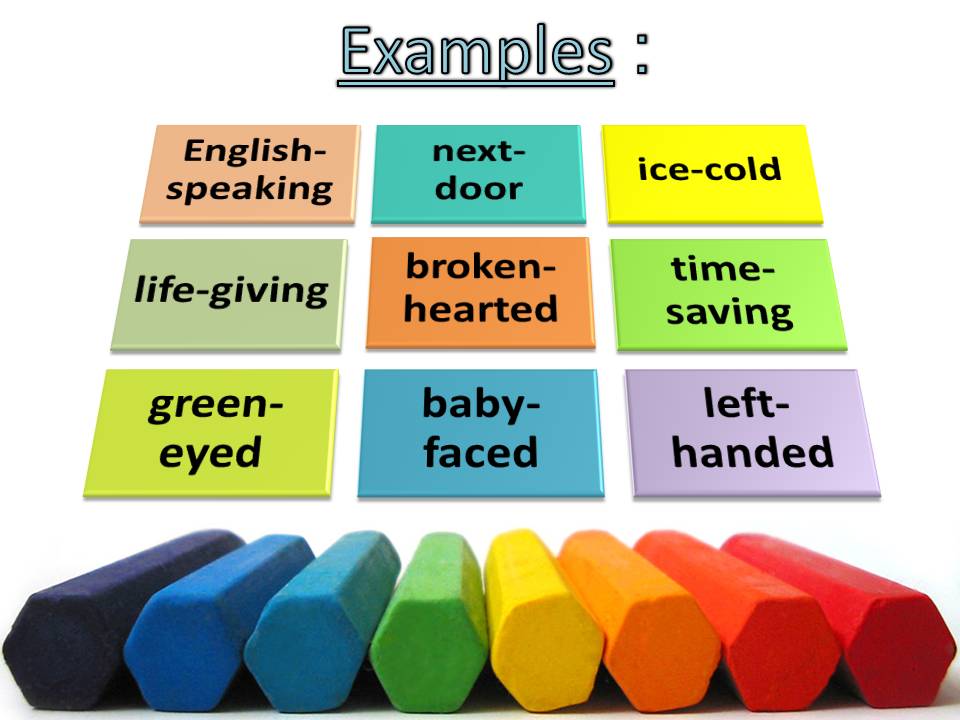 For instance, if you want to say that a building was designed after the style of the end of the century, you can write that it’s an end-of-the-century building. Astounding, isn’t it?
Actually, there are limits to this concept. To write about an end-of-the-period-when-there-were-two-German-states building would be a bit over the top. But you get the idea.
I’ve tried to put down some simple rules in German which you can download here. The hyphens are often omitted in modern business talk and advertising because they are seen as uncool. But that’s wrong. Keep the hyphens, they’re important. Or how would you tell the difference between a green-energy consultant and a green energy consultant without a hyphen?